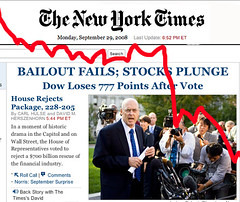
- Equity sectors: Financials are the worst space in the market, falling over 1.25% on weakness pretty much across the board. Industrials are off 1.25% on weakness in homebuilders, airlines, and building products.
- Discretionary is also off 1.25% on weakness in autos and IGT. Energy is in line with the tape, although refiners are weighing on the group due to lower crack spreads.
- Tech is slightly ahead of the tape as strength in JNPR, NOVL, and ERTS offsets weakness in semis (SOX off over 1.25%). Materials are outperforming a bit on strength in gold stocks and CF, although steels continue to act poorly and paper stocks also weigh on the group. Telecom is off just under 0.5%, outperforming on strength in VZ. Staples are off under 0.2% and outperforming on strength in beverages, DF, and HSY.
- Utilities are flattish on the day, outperforming the market on a defensive bid as investors look to reduce beta. Healthcare is up close to 0.25% on the day, the top space in the market, on strength in biotechs (AGN, GENZ, BIIB, and CELG) on news that Sanofi is looking to acquire a biotech company in the US.
Showing posts with label Investing. Show all posts
Friday, July 2, 2010
Equity sectors: Financials are the worst space in the market $GS $XLF $FAZDiscretionary is also off 1.25% on weakness in autos and IGT
Labels:
Business,
Copper,
Energy,
Gold,
Investing,
Natural gas,
Petroleum,
Stocks and Bonds
Thursday, July 1, 2010
Financials; Not a ton of real money buying on this pullback.; Sentiment remains extremely negative Senate's vote and tomorrow's $XLF
- ·Financials: Following last night's successful House vote on financial reform, the sector underperforms following disappointing Jobless Claims, ISM and Pending Home Sales data. Banks (especially the large caps) are weak in early trading.
- Volumes are heavy on the sell-off and increased dramatically following the 10am economic reports. Likewise, flows remain very active. The 10am number brought out real money sellers and led fast money to press shorts aggressively. Once we held the 1006 technical level, shorts to come in and cover.
- Haven't seen a ton of real money buying on this pullback. We're seeing some institutional support within life insurers and defensively positioned banks, but nowhere else.
- Sentiment remains extremely negative heading into the Senate's vote and tomorrow's June Employement report. As estimates continue to come down for Q2 earnings, it is unclear what positive catalyst (other than valuation arguments) is going to lift the group between now and Q2 report.
Monday, June 28, 2010
Friday, June 25, 2010
Financials Update at the Close $GS $XLF
· The financials were some of the best performing stocks in the whole market this week, although nearly all the gains came on Fri following the completion of financial regulatory form. Early Fri morning (5:30amET), the House/Senate reconciliation conference committees reached a compromise agreement on the last big outstanding issue (Lincoln’s derivatives amendment) and passed the bill (w/o any Republican support).
The measure will now head to the full Senate and House for a vote next week (the process is expected to start Tues) w/Obama on track to sign the legislation by Jul 4 (meeting his months-long deadline). The finished product will impose new restrictions and costs on the industry, although the final bill was not as bad as some feared (esp. on “Volcker” and “Lincoln”); the initial St takeaway on the legislation can be summed up by the following Bloomberg headline (“banks dodged a bullet as Congress dilutes US trading rules in overhaul”). While investors are relieved for now, a lot of the buying occurring Fri was either short-covering or quicker trader-types “renting” exposure via the XLF; not a lot of people were rushing to make purchases in “single stocks”. Some are looking back to the health care
Labels:
Bank,
Basel,
Business,
Investing,
Trade,
United States,
United States Congress,
United States Senate
Market Update – equities saw a brief relief-rally equities are on pace to decline each day of the week (something that hasn’t happened since ’09 $SPX
Market Update – equities saw a brief relief-rally bounce at the open as fin reg reform got passed through the reconciliation committee, although the strength was pretty quickly sold into (fins are managing to hold onto some of their gains heading into the afternoon) and the broader markets are flattish heading into the afternoon. While certain items in the bill were “softened” (Volcker + Lincoln), this is a 1500pg+ document (that hasn’t been published yet) that contains a lot of negatives for the financial services industry. Meanwhile, there have been a slew of sell-side # cuts on the brokers/capital markets banks in the last week, casting a cloud over the upcoming earnings season (which starts the week of Jul 12). Away from reg reform, news was quiet overnight/this morning. There were a few pretty strong tech
Friday, June 4, 2010
CEO Craig Donohue says $CME “ Were Not Looking to Trade Swaps” [Short Idea :theBack9]
:46 (Dow Jones) CME Group (CME) CEO Craig Donohue says CME will stick to its clearinghouse role when it comes to the swaps markets, which are being steered toward electronic trading platforms as part of wide-ranging new financial regulation package. "It's very possible for swap dealers or inter-dealer brokers to create their own alternative swap execution facilities," Donohue says at an industry event. These will be connected to clearinghouses like CME's, Donohue says, and that will continue to be CME's main focus. "That's what our customers are telling us they'd like to do," he says. (jacob.bunge@dowjones.com) Call us at (212) 416-2184 or email paul.vigna@dowjones.com Visit the Market Talk blog at http://www.djnmarkettalk.com
Click here to go to Dow Jones NewsPlus, a web front page of today's most important business and market news, analysis and commentary: http://www.djnewsplus.com/energ/al?rnd=vQKn781UOUcvU%2B4G48sZPw%3D%3D. You can use this link on the day this article is published and the following day.
Thursday, April 15, 2010
Lehman may have grounds to sue Goldman, Barclays
Goldman Sachs was the high bidder for Lehman’s equity derivatives at options and futures exchange CME Group Inc, and took $445 million of those assets at a private auction in September 2008, according to previously censored details of Valukas’s March 11 report. Barclays was the high bidder for Lehman’s energy derivatives and took $707 million in assets from CME.
Labels:
Bankruptcy,
Barclays,
Business,
CME Group,
Futures exchange,
Goldman Sachs,
Investing,
Lehman Brother
Thursday, April 8, 2010
Today’s Top Stories 04/08/10 $SPY $EWG $GS
Today's Top Stories
Keys for today: NYT says China yuan reval to come within next few days; Greek CDS @ all-time wides; ECB mtng due out this morning (focus on new lending rules); retailer sales hit all morning; LCC/UAUA in merger talks per NYT/WSJ; Kohn/Bernanke speak after bell
European shares were hit as Greek CDS spreads blow out to all-time wides (traded out 32bps to a record 445.5 overnight per CMA DataVision) despite positive comments from Greek officials (i.e. Greek central bank official said that bank deposit outflows have stopped, finance minister said Greece is continuing to borrow normally and is executing its fiscal consolidation plan on schedule, etc.). Also weighing on European shares were cautious comments from the Bank for Int'l Settlements (BIS) which said the UK needs "drastic" austerity measures to prevent public debt from exploding out of control and that the Sovereign debt crisis is at a "boiling point."Thursday, February 18, 2010
International Interest Rate Strategist Fiscal Pressures and Swap Spreads
• Concrete financial support is yet to materialize for Greece. We expect the
market’s focus to shift to issuance and implementation risks.
• Our analysis of swap spreads suggests scope for 10yr Bunds to trade flat and 10yr gilts to trade north of 30bp over swaps.
• The upcoming supply profile clearly supports 30yr Bunds over 30yr gilts.
• The 30yr TIPS auction on 22 February is likely to be a success. We see scope for the 10s20s TIPS real yield curve to flatten. Euro BEs wideners look
interesting.
• We include our end-February index projections for the EGBI, the UK, US,
Canada, Australia and Japan.
• The week beginning 22 February sees $126bn of UST issuance in the 2-, 5-
and 7-year sectors (equivalent to 815k DV01 10-year futures). The net cash
requirement in Euro continues to remain non-supportive until the week
commencing 1 March.
report here ------>>> CLick
Labels:
Australia,
Business,
Canada,
European Union,
Gilt-edged securities,
Investing,
Japan,
Yield curve
Yesterday’s Trading 02.17.10
· Equity Levels: SP500 ends 1099 (despite a few attempts failed to get up through 1100), up
4.6 points/0.4% on the day; Nazz ends up 0.5% (just shy of the 50day MA – 3 points under);
the R2K ends up 0.6% (remains above its 50day MA).
· Equities had a decent bid to them all session; Helping the tape today: 1) some pos.
headlines out of Europe (the strong Spain debt issue and the Greek Jan budget coming in
better than expected; late in the session, the FT said Greece would attempt to come to market
next week w/a syndicated loan issue to build credibility w/investors); 2) earnings – WFMI
and DE are the highlights in the US while financials stood out overnight (on Tues it was
Barclays and Wed morning ING rallied); 3) eco numbers better-than-expected (housing
starts and IP; also – the Jan budget statement @ 2pmET came in lower/better than expected);
4) Washington headlines – the Treasury reported late in trading that permanent mortgage
modifications jumped 75% M/M in Jan while Obama held a press conf today talking up the
benefits of the stimulus program this morning (and the WSJ noted that the bulk of the
infrastructure stimulus is still to come).
· Desk color - Despite the modest rally, volumes/attendance/conviction levels all remain on the
light side and the SP500 failed to sustain a move north of the technically important 1100
level. That said, stocks were able to shrug off a strong dollar rally (the DXY closes up 0.9%
and more than makes up for Tues’ weakness) and some hawkish Fed headlines (the minutes
were as expected although the line about “several” Fed officials wanting asset sales in the
near-term spooked some people). A lot of the flow continues to come from short-term
focused HFs while larger vanillas haven’t done a whole lot in the last 72 trading hours.
Continue to see a sellers strike although a lot of the aggressive short covering is starting to
abate (the covering really kicked off after we failed to follow through on the downside back
on 2/5 but has been petering out in the last couple sessions). Longs didn’t have enough to
break through 1100 as real vanilla buyers on the sidelines.
· Equity Sectors – similar to mid-day, weakness in the commodity-linked stocks on back of
the stronger buck (this group saw some profit taking following big ramps during Tues’
session; despite the dollar more than recouping Tues’ sell-off, materials/energy stocks only
pulled back small today). Financials trade inline w/the sp500 helped by large banks (C,
BAC), life insurance (off the Morgan Stanley sector upgrade), and REITs (continued M&A
optimism) while the regional banks were weak. Health care led the market for the whole
session (the HMOs in particular had a bid to them today). SP500 staples index was one of the
best performing groups, although a lot of this was on back of WFMI (which advanced double
digit % after earnings). Capital Goods outperformed on back of DE’s earnings.
· Best Performing SP500 stocks (from Bloomberg): WFMI, SNDK, IRM, DE, BSX, THC,
DPS, GILD, GT, CFN
· Weakest performing sp500 stocks (from Bloomberg): FMC, NBR, RF, TSO, CBG, MOT,
IGT, AIG, JDSU, SRE
· Equity Levels: SP500 ends 1099 (despite a few attempts failed to get up through 1100), up
4.6 points/0.4% on the day; Nazz ends up 0.5% (just shy of the 50day MA – 3 points under);
the R2K ends up 0.6% (remains above its 50day MA).
· Equities had a decent bid to them all session; Helping the tape today: 1) some pos.
headlines out of Europe (the strong Spain debt issue and the Greek Jan budget coming in
better than expected; late in the session, the FT said Greece would attempt to come to market
next week w/a syndicated loan issue to build credibility w/investors); 2) earnings – WFMI
and DE are the highlights in the US while financials stood out overnight (on Tues it was
Barclays and Wed morning ING rallied); 3) eco numbers better-than-expected (housing
starts and IP; also – the Jan budget statement @ 2pmET came in lower/better than expected);
4) Washington headlines – the Treasury reported late in trading that permanent mortgage
modifications jumped 75% M/M in Jan while Obama held a press conf today talking up the
benefits of the stimulus program this morning (and the WSJ noted that the bulk of the
infrastructure stimulus is still to come).
· Desk color - Despite the modest rally, volumes/attendance/conviction levels all remain on the
light side and the SP500 failed to sustain a move north of the technically important 1100
level. That said, stocks were able to shrug off a strong dollar rally (the DXY closes up 0.9%
and more than makes up for Tues’ weakness) and some hawkish Fed headlines (the minutes
were as expected although the line about “several” Fed officials wanting asset sales in the
near-term spooked some people). A lot of the flow continues to come from short-term
focused HFs while larger vanillas haven’t done a whole lot in the last 72 trading hours.
Continue to see a sellers strike although a lot of the aggressive short covering is starting to
abate (the covering really kicked off after we failed to follow through on the downside back
on 2/5 but has been petering out in the last couple sessions). Longs didn’t have enough to
break through 1100 as real vanilla buyers on the sidelines.
· Equity Sectors – similar to mid-day, weakness in the commodity-linked stocks on back of
the stronger buck (this group saw some profit taking following big ramps during Tues’
session; despite the dollar more than recouping Tues’ sell-off, materials/energy stocks only
pulled back small today). Financials trade inline w/the sp500 helped by large banks (C,
BAC), life insurance (off the Morgan Stanley sector upgrade), and REITs (continued M&A
optimism) while the regional banks were weak. Health care led the market for the whole
session (the HMOs in particular had a bid to them today). SP500 staples index was one of the
best performing groups, although a lot of this was on back of WFMI (which advanced double
digit % after earnings). Capital Goods outperformed on back of DE’s earnings.
· Best Performing SP500 stocks (from Bloomberg): WFMI, SNDK, IRM, DE, BSX, THC,
DPS, GILD, GT, CFN
· Weakest performing sp500 stocks (from Bloomberg): FMC, NBR, RF, TSO, CBG, MOT,
IGT, AIG, JDSU, SRE
Labels:
Bloomberg,
Business,
Equities,
Greece,
Investing,
Morgan Stanley,
Stocks and Bonds,
Washington
2.18.10 Today’s Top Stories & Catalysts
Today’s Top Stories & Catalysts
· Focus for the most part remains on Europe with little out of Asia (BoJ decision pretty
much as expected and HK’s unemployment rate was unchanged) as China remaining closed.
On the Greek front, no major developments to speak of overnight (to watch coming up
though: the FT is reporting that Greece may test the waters next week w/a bond offering and
the country is expected to deliver more information by Fri 2/19 on its debt swap deals).
There were a handful of earnings out in Europe - Daimler is prob. the standout, w/the
stock off ~7% after reporting disappointing numbers and proposing a dividend cut. SocGen is
down 5% post its earnings (first disappointing European financial report this week after very
strong Barclays and ING #s) although other European financials aren't really getting hit in
sympathy. In London, BT is the weakest stock in the FTSE following a ratings downgrade
from S&P (there are continued worries about the co's pension exposure). On the eco front,
the UK posted a budget deficit for January vs. expectations for a surplus, putting UK
sovereign debt under some pressure (FT).
· tech update from Wed night - big night of earnings - on the whole numbers/trends/mgmt
commentary all remain positive, although inline w/what we heard from companies back in Jul
and also inline w/CSCO's Chambers a couple weeks back. Trends were robust in the CQ4,
trends remained strong in Jan, the CQ1 is shaping up to be better-than-seasonal for many endmarkets,
and mgmt tone remains sanguine on the outlook. The next big catalyst for tech will
be the sell-side conference season and the mid-Q updates - Goldman has a conf next week
and Morgan Stanley the week after - these forums will give companies a chance to update on
the status of Q1 (i.e. are things still pacing better-than-seasonal; how is the outlook for June
shaping up; etc). Also - we will start getting formal mid-Q updates in early Mar. Some
tidbits from Wed night: 1) HPQ tone remains positive on demand; PCs prob. showed biggest
upside (revs much better than St), which isn't surprising given what others have said/reported
(MSFT, INTC, etc); HPQ mgmt said it was component constrained (similar to what others,
inc. CSCO, have said); 2) AMAT beat and raised; tone was positive; one analyst on the call
noted that backing into CH2:10 guidance based on mgmt's color implies a down back-half (if
I take the 25% revenue growth you gave in the April quarter, 100% year on year growth, I
think you are actually talking about a 50% revenue decline from the April quarter level into
July and October"); that said AMAT was sanguine on the outlook looking into ’11; 3) NVDA
said it remained capacity constrained throughout the Q and will remain so into the Apr-end Q
(NVDA said this cost them a couple hundred million in revs in the Q and that they would
have guided for higher Apr revs). Big to watch tonight in techland - DELL and IM earnings.
· Gold sales - IMF to Begin On-Market Sales of Gold – hit after the US close on Wed – IMF
said Wed night it will soon kick off the second phase of its gold sales process. The first
phase was set aside exclusively for off-market sales to official holders. The total amount
remaining to be sold is 191.3 metric tons. In accordance with the priority of avoiding
disruption of the gold market, the on-market sales will be conducted in a phased manner over
time.
· China & US tensions growing on economic front - US officials increasingly view the
Chinese currency’s artificially low peg as a threat to worldwide economic stability; the US
plans to press Chinese officials in the coming months to take action and strengthen the yuan.
In addition, US multinational corporations are becoming increasingly vocal about what they
view as anti-competitive practices on the part of the Chinese – WSJ
· Muni market – cities weigh Chapt 9 filings – the WSJ says municipalities around the
country are considering whether to file for Chpt 9 bankruptcy protection; also on the muni
front: States see ~$1T benefits “sinkhole” (there is a massive gap between what states have
promised in pensions, health care, and other benefits, and the available resources)
· Retail earnings season kicks off – WMT earnings due to hit @ 7amET this morning; JCP
comes Fri morning.
· US bank lending falls at fastest rate in history – bank lending in the US has contracted so far in ’10 at the fastest rate in history, raising worries that the Fed is withdrawing its
emergency stimulus measures too early. The M3 broad money supply has been contracting at
a rate of 5.6pc over the last three months. This signals future deflation. London Telegraph.
· Earnings season recap – from JPMorgan’s E Beinstein - Roughly 75% of the non-financial companies in our High Grade bond index have filed their 4Q09 reports. This preliminary data suggests credit metrics continue to improve, but the complexion of the improvement has changed. Recall, trends in 3Q09 credit metrics were positive across almost all sectors. These trends continue in 4Q09, but with a different tone. While companies continue to accumulate cash, the pace is slower. With cost cutting largely finished, profit margins have ticked down as companies must spend more to grow. While leverage has likely peaked earlier in 2009, its reduction will likely be gradual.
· Focus for the most part remains on Europe with little out of Asia (BoJ decision pretty
much as expected and HK’s unemployment rate was unchanged) as China remaining closed.
On the Greek front, no major developments to speak of overnight (to watch coming up
though: the FT is reporting that Greece may test the waters next week w/a bond offering and
the country is expected to deliver more information by Fri 2/19 on its debt swap deals).
There were a handful of earnings out in Europe - Daimler is prob. the standout, w/the
stock off ~7% after reporting disappointing numbers and proposing a dividend cut. SocGen is
down 5% post its earnings (first disappointing European financial report this week after very
strong Barclays and ING #s) although other European financials aren't really getting hit in
sympathy. In London, BT is the weakest stock in the FTSE following a ratings downgrade
from S&P (there are continued worries about the co's pension exposure). On the eco front,
the UK posted a budget deficit for January vs. expectations for a surplus, putting UK
sovereign debt under some pressure (FT).
· tech update from Wed night - big night of earnings - on the whole numbers/trends/mgmt
commentary all remain positive, although inline w/what we heard from companies back in Jul
and also inline w/CSCO's Chambers a couple weeks back. Trends were robust in the CQ4,
trends remained strong in Jan, the CQ1 is shaping up to be better-than-seasonal for many endmarkets,
and mgmt tone remains sanguine on the outlook. The next big catalyst for tech will
be the sell-side conference season and the mid-Q updates - Goldman has a conf next week
and Morgan Stanley the week after - these forums will give companies a chance to update on
the status of Q1 (i.e. are things still pacing better-than-seasonal; how is the outlook for June
shaping up; etc). Also - we will start getting formal mid-Q updates in early Mar. Some
tidbits from Wed night: 1) HPQ tone remains positive on demand; PCs prob. showed biggest
upside (revs much better than St), which isn't surprising given what others have said/reported
(MSFT, INTC, etc); HPQ mgmt said it was component constrained (similar to what others,
inc. CSCO, have said); 2) AMAT beat and raised; tone was positive; one analyst on the call
noted that backing into CH2:10 guidance based on mgmt's color implies a down back-half (if
I take the 25% revenue growth you gave in the April quarter, 100% year on year growth, I
think you are actually talking about a 50% revenue decline from the April quarter level into
July and October"); that said AMAT was sanguine on the outlook looking into ’11; 3) NVDA
said it remained capacity constrained throughout the Q and will remain so into the Apr-end Q
(NVDA said this cost them a couple hundred million in revs in the Q and that they would
have guided for higher Apr revs). Big to watch tonight in techland - DELL and IM earnings.
· Gold sales - IMF to Begin On-Market Sales of Gold – hit after the US close on Wed – IMF
said Wed night it will soon kick off the second phase of its gold sales process. The first
phase was set aside exclusively for off-market sales to official holders. The total amount
remaining to be sold is 191.3 metric tons. In accordance with the priority of avoiding
disruption of the gold market, the on-market sales will be conducted in a phased manner over
time.
· China & US tensions growing on economic front - US officials increasingly view the
Chinese currency’s artificially low peg as a threat to worldwide economic stability; the US
plans to press Chinese officials in the coming months to take action and strengthen the yuan.
In addition, US multinational corporations are becoming increasingly vocal about what they
view as anti-competitive practices on the part of the Chinese – WSJ
· Muni market – cities weigh Chapt 9 filings – the WSJ says municipalities around the
country are considering whether to file for Chpt 9 bankruptcy protection; also on the muni
front: States see ~$1T benefits “sinkhole” (there is a massive gap between what states have
promised in pensions, health care, and other benefits, and the available resources)
· Retail earnings season kicks off – WMT earnings due to hit @ 7amET this morning; JCP
comes Fri morning.
· US bank lending falls at fastest rate in history – bank lending in the US has contracted so far in ’10 at the fastest rate in history, raising worries that the Fed is withdrawing its
emergency stimulus measures too early. The M3 broad money supply has been contracting at
a rate of 5.6pc over the last three months. This signals future deflation. London Telegraph.
· Earnings season recap – from JPMorgan’s E Beinstein - Roughly 75% of the non-financial companies in our High Grade bond index have filed their 4Q09 reports. This preliminary data suggests credit metrics continue to improve, but the complexion of the improvement has changed. Recall, trends in 3Q09 credit metrics were positive across almost all sectors. These trends continue in 4Q09, but with a different tone. While companies continue to accumulate cash, the pace is slower. With cost cutting largely finished, profit margins have ticked down as companies must spend more to grow. While leverage has likely peaked earlier in 2009, its reduction will likely be gradual.
Whole Foods We Now Love Austin for 2 Reasons; Upgrade to Overweight
We are upgrading Whole Foods to Overweight from Neutral and
increasing our price target to $39 from $32. As we highlighted in our long
trading call yesterday, “Whole Foods: Recipe for a Squeeze, Buyers
Ahead of 1Q Print,” we expected a combination of positive ID sales
(+2.5%) and store contribution margin expansion (73 bps of expansion, ex.
LIFO) to lead to a clean EPS beat ($0.06 ahead of consensus) but were
concerned about the sustainability of emerging sales trends longer term.
With the strong ID sales and margin results, we are now more confident
that WFMI's emerging sales growth trends have been validated and feel an
OW rating is merited. Moreover, in line with our new Bull’s-Eye
investment strategy that we’ve adopted for 2010 (see note out today,
“Broadlines Retailing: Barbell Out, Bull's-Eye In; 2010 Handbook &
4Q Look”), WFMI is demonstrating early signs of two of the three
attributes we’re looking for, specifically: identifiable sales catalysts (via
trade-up and value focus) and strong top-line momentum (with traffic the
key driver). In addition, the stock already fully embodies the third
attribute, out-of-favor opportunities (with a ~10% short interest ratio).
While WFMI will likely open higher tomorrow, we think management has
left room for additional EPS upside – hence our upgrade.
full report here
Tuesday, February 16, 2010
Global ABS/CDO Weekly Market Snapshot
The certifying analyst(s) is indicated by AC. See last page of the report for analyst certification and important legal and regulatory disclosures.
Save the Date: April 15, 2010, J.P. Morgan Securitized Products Research Conference, 383 Madison Ave, NYC
Investment Themes: The ABS market remained solid this week. Short high quality bonds continue to trade very well. Riskier bonds
held up, although the aggressive bids that started the year have faded. We stay Overweight benchmark Consumer ABS as Treasury
surrogates. We recommend Overweight cash Subprime RMBS based on favorable loss-adjusted yields and technicals. On ABX, we
stay Neutral and would express that in a 06-1 trade to sell the PEN.AAA and buy the LCF.AAA.
This Week: US ABS. A $470mn Prime Auto Loan ABS priced this week. This brings year-to-date Auto-related ABS (Loan, Lease,
and Fleet) supply to roughly $7bn. In addition, the auto captives have been active in Dealer Floorplan ABS issuance with close to $4bn.
In total, year-to-date ABS volume stands at $14bn. Over the last two rounds (January and February), TALF loan subscriptions totaled
just $1.7bn across ABS (excluding $0.4 in Small Business), a sign of the program’s diminishing significance. The TALF program since
inception saw approximately $56bn in loan subscriptions for ABS. ABS spreads remained firm on the week with generally orderly and
stable trading across sectors. ABX prices were also unchanged on low volumes.
European ABS. It was a quiet week in primary European markets, with one structure-to-repo transaction from ING and a marketing
roadshow for a pass-through UK prime RMBS. Secondary markets saw some generic widening on the back of volatility in the
sovereign space, but more on observable prices as opposed to traded levels.
CDOs. CLOs emerged relatively unscathed from the week’s volatility. US CLO AAAs stayed at 215bp while AAs, single-As, BBBs,
and BBs were down only a few points to $82, $70, $60, and $45 as buyers stepped in. European CLOs are unchanged, though tiering
between stronger and weaker bonds is more pronounced. We note US investors are increasingly buying into the basis, and see
European single-As to AAAs as the primary beneficiaries. CLOs will not be impervious to heightened risk aversion, renewed sovereign
and policy risks, and the gradual withdrawal of monetary stimulus (e.g., China again raised its reserve requirement), but given the
relative value to comparables, we stay Overweight and point out the negative net supply which cushions against major price weakness.
Further, we recently proposed AAA CLO paper as a ‘safe haven’ trade to weather the volatility, à la Consumer ABS. So far this has
proved to be the case, with tighter AAA spreads and Super Senior bonds moving to inside 150bp, within striking distance of our
midyear 100-150bp spread target. However, the strength in US CLO equity is interesting. Strong performers are well bid by those
seeking higher yields, and in some cases investors are paying 3-4 years of cashflows for performing US CLO equity, implying prices as
high as the $50s-60s (lower for non-performers). At these levels, pricing takes the view of incremental improvement in O/C and excess
spread, particularly as existing CLOs reinvest in primary loans issued with historically wider spread margins. We broadly agree, but
point out the transaction-specific risks of this strategy.
In the News: Fitch upgraded three subordinate classes of FORDO 2007-A by one category and affirmed the seniors at AAA. Moody’s
upgraded various tranches of AMCAR 2005-2006 transactions. S&P upgraded 2008-1 subordinates and affirmed 2009-1 classes of
Huntington Auto Trust ABS. FULL REPORT HERE
Citibank- Goldman Sachs
We have removed the NR designation from Citigroup shares. We reinstate
a Neutral rating on Citigroup with a 12-month price target of $3.50. The
first phase of Citigroup’s restructuring is now complete with capital and
liquidity levels higher than at its peers. With leverage significantly
reduced, the “trade to tangible book” looks tempting. That said, we
reinstate our rating on Citigroup at Neutral as (1) near-term earnings
power remains weak, (2) the stock offers less “provision leverage” than
pure US plays, and (3) The government stake likely caps near term upside.
FULL REPORT HERE
Labels:
Business,
Capital,
Citigroup,
Government,
Investing,
Market liquidity,
Share,
Stocks and Bonds
Barclays Report
Image via CrunchBase
of £11,626mn and 2% better than company consensus. Underlying
PBT came in at £11,720mn a 5.7% beat to JPMe of £11,090mn
adjusted for: (i) total write downs of £6,086mn; (ii) loss on own debt
of £1,820mn; (iii) £6,579mn gain on sale of BGI and others; and (iv)
£1,249mn gain on exchange offers. Note that we have not adjusted
earnings for a £1,162mn gain from a structural equity hedge and
£1,364mn from an interest rate hedge.
• We have focused on three main areas;
• Resilient revenues at BarCap – PBT was in line although revenues
were better than expected, especially relative to their IB peers. Q4
revenues came in at £3,673mn (JPME £3,339mn) flat on Q3 whereas
IB peers have seen this fall on average by c.30%. We suspect this is a
result of strong origination volumes. Total write downs were slightly
higher than what we expected but they made up for it on the expense
line with a clean cost to income ratio of 42% in Q409 compared to
50% in Q3. BarCap reported a comp ratio of 38% in Q4.
• Provisions better than consensus and company guidance -
Provisions came in line with our estimates at 135bps of average loans
compared to guidance of 130-150bps. Going forward we expect a
13% absolute decline in this number.
• Capital came in better – RWAs fell by more than expected to £383bn
(-6% HoH). As a result core Tier 1 ratio came in better at 10% and we
have adjusted our RWAs estimates going forwards.
• Valuation – We increased our SoP based PT from 280p to 305p to
reflect a better capital position and improvement in earnings. Our new
stated NAV for 2010E is now 352p (old 330p) and JPM adjusted NAV
286p (old 265p) which implies Barclays is trading on 0.8x 2010E
NAV. Barclays (N) remains our favourite UK domestic bank.
FULL REPORT HERE
Labels:
Barclays,
Barclays Global Investors,
Business,
Funds,
Hedge fund,
Investing,
JPM,
JPMorgan Chase
Cashin’s Comments AN ENCORE PRESENTATION 02.16.10
Cashin’s Comments
On this day (-1) in 1922, a 28 year old kid named Sam Hammett resigned from the
Pinkerton Detective Agency. The Pinkerton's were the most famous detective agency
in the world. Begun over 60 years earlier, Alan Pinkerton's firm was the model for the
U.S. Secret Service. And, when Pinkerton took his tactics private, he chose as his logo
an open and possibly all-seeing eye. Thus the Public adopted the image of a nonpolice
detective as a "private eye."
Sam Hammett resigned from what he thought had become a bureaucratic form of
investigation. He liked free style - lone wolf. So he left the firm, dropped his first
name and began to write about the private eye he always dreamed he'd be.
So Sam Hammett became the writer Dashiel Hammett and invented Sam Spade (The
Maltese Falcon) as well as Nick Charles (The Thin Man) and set the tone of hard
boiled, hard drinking shamuses that would captivate Americans for half a century.
To celebrate, tell Vilma to park the gum, and tell the skirt on the phone that a partner
is a partner not a prom date. And if a messenger arrives with a newspaper-wrapped
dingus - send it, along with most of whatever else you have, to the I.R.S.
Traders could have used a detective to tell them what was going on yesterday last
week. The markets puzzled about what was the solution to the Greek question and
what was going on in China. That puzzling led to some volatile trading.
Following The Bouncing Buck Continues But Causes Confusion – Stocks began
Friday’s session deep in the hole. Pundits noted another move to tighten by China.
Of nearly equal importance was the noticeable lack of detail on the presumed Greek
“rescue package”. Traders began to wonder if there really was a plan.
Those two developments gave a boost to the dollar. That, in turn, sent gold and oil
sharply lower, matching the opening stock selloff.
Around 10:00, the greenback rally paused. Less threatened, stocks, gold and oil
responded by churning sideways. As noon approached, the dollar index came off the
highs and, in yet one more Pavlovian reaction, stocks, oil and gold cut their losses in
response.
Then, around 1:00, the Dollar Index (DXY) began to move up toward the morning
highs. As if a bell had rung – stocks, oil, and gold headed back down. Shortly after
2:00, the process was reversed again. In the final 45 minutes, they staged a minor
reversal of the previous reversal.
The dominance of the dollar was so evident that I was stunned from time to time to
see brokers getting calls from trading desks inquiring “what turned the market?”
Talk about not seeing the forest for the trees.
The Dow closed two-thirds off the lows. That allowed the first up week in the last
five. Not quite a resounding victory for the bulls, but a welcome respite at least.
The Week Ahead – Based upon published data, the watercooler wizards are
guessing that this week’s calendar may look something like this:
In the abbreviated week, it is likely that initial claims and housing data will get much
attention. If the FOMC minutes are
not too heavily laundered, they might tell us if Hoenig is a lone hawk.
Cocktail Napkin Charting – In Friday’s Comments, we wrote that the napkins suggested support in the S&P was “way
down around 1058/1063”. The sharp opening selloff took the S&P to an intra-day low of 1062.97 before they circled the
wagons. For today, we’ll stick with the 1058/1063 support. Resistance looks like 1083/1088 and then 1093/1097.
China Watch – Over the weekend, there was some speculation that China is so concerned about a lending bubble and
potential inflation that they might allow (cause) their currency to appreciate. If so, authorities must be really concerned.
On another note, Andy Lees passed along a warning from China’s Agriculture University. They claim the over-use of nitrogen fertilizers has so poisoned the soil in South China that nothing will grow in it. The year of food shortages?
Greece And The Euro – The Euro is firming this morning helping gold, oil and stock futures.
The European ministers are meeting amid a growing sense that failure is not an option. Additionally, polls show that a majority of the Greek populace believe austerity measures are necessary and, likely, overdue. That offers some hope of reform without street backlash.
Sunspots Before My Eyes – Sunspot activity perked up markedly last week. In fact, the numbers returned to almost
normal levels. The sunspot numbers for February 4th through the 10th were: 11, 22, 30, 51, 71, 63 and 55. We haven’t
seen a number as large as 71 since spring of 2006.
To keep things in perspective, lets again review the average daily sunspot numbers in prior years. For the period from 1999
through 2009, the average daily sunspot numbers were 136.3; 173; 170.3; 176.6; 109.2; 68.6; 48.9; 26.1; 12.8; 4.7 and 5.
Let’s not put away that sweater just yet.
Consensus – It’s still all about the dollar (DXY). The above noted hopes for some resolution to the Greek crisis have gold, oil and stock futures all doing better. In 17 of the last 20 weeks, we’ve begun with a rally. Follow the bouncing buck.
Stay very, very nimble.
Trivia Corner
Answer - The only letter not used in spelling the names of all 50 states is "Q".
Today’s Question – Two term presidencies are not as common as you think. We’ve only had three back to back two termers once in our history. Who were they?
Americas Equity Morning Summary 02.15.10
Companies Featured
AMAT.O, APD.N, BWLD.O, CRM.N, EVVV.O, GILD.O, GPS.N, JCP.N,
JWN.N, PNRA.O, PX.N, RHT.N, STR.N, ZION.O
Commodities/Commodity Market Report-
Energy prices increased last week, as did most commodities, as risk aversion eased slightly. Oil
led the pack, despite a bearish US DOE report which showed crude, gasoline and distillate
inventories registering weaker-than-expected. Base metals reversed the past couple of weeks’
weakness following a more upbeat mood in equity markets and benign Chinese inflation data.
Precious metals last week recovered from recent weakness after the dollar lost some ground
against the euro ahead of a meeting of Eurozone finance ministers, although concerns over
sovereign risk in the region may continue to support the US currency. Agriculturalprices finished
higher, following the general commodity rally on reduced risk aversion.
US Economics/A European Slowdown Would Only Nick the US
The European sovereign debt crisis may net to slower European growth. Rising risk premiums on
the region’s sovereign debt, constraints on its banks, and fiscal tightening will weigh on growth in
peripheral economies and may spill into the core countries. A weaker euro will be an offset. We
estimate that a one-percentage-point slowdown in European growth might shave 0.2% from that
in the US. Three channels matter: exports, earnings and financial linkages. Europe accounts for
about 29% of our exports, 8% of S&P revenues, and 4.6% of US banks’ totals assets. Contagion
spreading from the European banking system is the biggest tail risk. If the crisis spills over into
broader risk aversion and a drying up of liquidity — the functional equivalent of the US subprime
crisis — the consequences could be more dire.
STEP Commentary/Changes to the Growth STEP
We are adding a 4% position in Express Scripts ($86.43), Ricky Goldwasser’s top pick in her
recently launched coverage of the Healthcare Services group and also one of five top global
picks highlighted by Morgan Stanley's healthcare analysts around the world. Express Scripts
looks well positioned to benefit from the shift to generics from branded drugs over the next five
years, increased exposure to specialty drugs, and meaningful earnings accretion from the NetRx
acquisition, and Ricky sees earnings more than doubling over the next three years. We are
removing the portfolio’s 4% position in Amgen ($56.48). There is no change to Steve Harr’s OW
rating on Amgen, but for the purposes of the Growth STEP, we prefer to move to the sidelines
and shift the portfolio’s position into what we view as a more robust growth story.
Economics Calendar
02/17: Housing Starts (January), forecast: 540,000
02/17: Industrial Production / Capacity Utilization (January), forecast: + 1.1 % / 72.9%
02/18: Producer Price Index/ Core (January), forecast: +0.8 % / +0.1%
02/18: Leading Indicators (January), forecast: +0.3 %
FULL REPORT HERE
02/19: Consumer Price Index/ Core (January), forecast: +0.3 % / +0.1%
M O R G A N S T A N L E Y R E S E A R C H
N O R T H A M E R I C A
AMAT.O, APD.N, BWLD.O, CRM.N, EVVV.O, GILD.O, GPS.N, JCP.N,
JWN.N, PNRA.O, PX.N, RHT.N, STR.N, ZION.O
Commodities/Commodity Market Report-
Energy prices increased last week, as did most commodities, as risk aversion eased slightly. Oil
led the pack, despite a bearish US DOE report which showed crude, gasoline and distillate
inventories registering weaker-than-expected. Base metals reversed the past couple of weeks’
weakness following a more upbeat mood in equity markets and benign Chinese inflation data.
Precious metals last week recovered from recent weakness after the dollar lost some ground
against the euro ahead of a meeting of Eurozone finance ministers, although concerns over
sovereign risk in the region may continue to support the US currency. Agriculturalprices finished
higher, following the general commodity rally on reduced risk aversion.
US Economics/A European Slowdown Would Only Nick the US
The European sovereign debt crisis may net to slower European growth. Rising risk premiums on
the region’s sovereign debt, constraints on its banks, and fiscal tightening will weigh on growth in
peripheral economies and may spill into the core countries. A weaker euro will be an offset. We
estimate that a one-percentage-point slowdown in European growth might shave 0.2% from that
in the US. Three channels matter: exports, earnings and financial linkages. Europe accounts for
about 29% of our exports, 8% of S&P revenues, and 4.6% of US banks’ totals assets. Contagion
spreading from the European banking system is the biggest tail risk. If the crisis spills over into
broader risk aversion and a drying up of liquidity — the functional equivalent of the US subprime
crisis — the consequences could be more dire.
STEP Commentary/Changes to the Growth STEP
We are adding a 4% position in Express Scripts ($86.43), Ricky Goldwasser’s top pick in her
recently launched coverage of the Healthcare Services group and also one of five top global
picks highlighted by Morgan Stanley's healthcare analysts around the world. Express Scripts
looks well positioned to benefit from the shift to generics from branded drugs over the next five
years, increased exposure to specialty drugs, and meaningful earnings accretion from the NetRx
acquisition, and Ricky sees earnings more than doubling over the next three years. We are
removing the portfolio’s 4% position in Amgen ($56.48). There is no change to Steve Harr’s OW
rating on Amgen, but for the purposes of the Growth STEP, we prefer to move to the sidelines
and shift the portfolio’s position into what we view as a more robust growth story.
Economics Calendar
02/17: Housing Starts (January), forecast: 540,000
02/17: Industrial Production / Capacity Utilization (January), forecast: + 1.1 % / 72.9%
02/18: Producer Price Index/ Core (January), forecast: +0.8 % / +0.1%
02/18: Leading Indicators (January), forecast: +0.3 %
FULL REPORT HERE
02/19: Consumer Price Index/ Core (January), forecast: +0.3 % / +0.1%
M O R G A N S T A N L E Y R E S E A R C H
N O R T H A M E R I C A
Labels:
Business,
Economics,
Eurozone,
Finance,
Investing,
Morgan Stanley,
Stock market,
United States dollar
Sunday, February 14, 2010
The Party is over, No More Free Rides
Downunder Daily Reconsidering the Set-back
Quick Comment: We didn’t expect a setback to risk assets so soon in 2010. We’re still not convinced that this is the ‘big one’ – we expect a 20%-plus peak-to-trough decline in developed equities some time this year – but we’re learning to be less dogmatic about that. Here are some thoughts:
First, correlation is back. We had thought that there would be more diversity in returns this year, but risk assets have again been highly correlated (Exhibit 1). There’s been nowhere to hide. To be fair, this is partly because there’s been adverse news on a broad front (sovereign stress, Chinese tightening, financial sector taxes and/or re-regulation).
Second, the equity performance pecking order remains unchanged. Those markets that did worse in 2008 did best in 2009 and have done worse (again) this year (Exhibit 2). There have been a few outliers, but they are easy to explain (no surprise, for example, that Spanish and Greek equities have under-performed).
This suggests that most investors now hold their views (and positions) with low conviction. After a cycle where the unthinkable happened, it seems few are willing to stand in the way of a sentiment shift. This will make for fast, flighty markets for some time. Nimbleness will be
important, even if, for now, discrimination is not.
It also suggests that low-conviction investors are playing by the standard rule book even though, in our view, the rules should have changed. So, for example, seeing Asia as the high-beta play on the global growth cycle ignores the fact that one uncertainty from two years ago is now gone. We now know how Asia would cope with a western-world downturn: it coped well. Asia passed the 2008 crisis not unscathed, but in sound structural shape.
That matters: we think a new synchronized globaldownturn remains unlikely. It also suggests that Asian equities (and EM generally) should do better than DM on a medium-term view.
VENTURE CAPITAL HERE
12321000000
Quick Comment: We didn’t expect a setback to risk assets so soon in 2010. We’re still not convinced that this is the ‘big one’ – we expect a 20%-plus peak-to-trough decline in developed equities some time this year – but we’re learning to be less dogmatic about that. Here are some thoughts:
First, correlation is back. We had thought that there would be more diversity in returns this year, but risk assets have again been highly correlated (Exhibit 1). There’s been nowhere to hide. To be fair, this is partly because there’s been adverse news on a broad front (sovereign stress, Chinese tightening, financial sector taxes and/or re-regulation).
Second, the equity performance pecking order remains unchanged. Those markets that did worse in 2008 did best in 2009 and have done worse (again) this year (Exhibit 2). There have been a few outliers, but they are easy to explain (no surprise, for example, that Spanish and Greek equities have under-performed).
This suggests that most investors now hold their views (and positions) with low conviction. After a cycle where the unthinkable happened, it seems few are willing to stand in the way of a sentiment shift. This will make for fast, flighty markets for some time. Nimbleness will be
important, even if, for now, discrimination is not.
It also suggests that low-conviction investors are playing by the standard rule book even though, in our view, the rules should have changed. So, for example, seeing Asia as the high-beta play on the global growth cycle ignores the fact that one uncertainty from two years ago is now gone. We now know how Asia would cope with a western-world downturn: it coped well. Asia passed the 2008 crisis not unscathed, but in sound structural shape.
That matters: we think a new synchronized globaldownturn remains unlikely. It also suggests that Asian equities (and EM generally) should do better than DM on a medium-term view.
VENTURE CAPITAL HERE
12321000000
Labels:
Asia,
Asset,
Business,
Business and Economy,
Chinese language,
Financial services,
Investing,
Stock
Saturday, February 13, 2010
What Is Wrong With the Job Market and How to Fix It Mark Zandi
Image via Wikipedia
Image via Wikipedia
Image via Wikipedia
The struggling job market is the most serious threat to the fledgling economic recovery. In a typical business cycle, recession occurs when consumer and business demand is undermined by a shock such as a surge in oil prices, a stock market crash, or—as in the current cycle—the bursting of a house price bubble. Businesses respond by slashing investment and payrolls to cut costs and stabilize profits. As they do, investors, who had driven down stock prices leading up to the recession, now bid prices up. With better profit margins and higher stock prices, businesses stop cutting and recession gives way to recovery. A self-sustaining expansion takes hold when businesses feel comfortable enough to invest and hire. In the current business cycle, profits and stock prices have risen, businesses have stopped cutting, and recovery has begun. But because employers have yet to resume hiring, expansion remains elusive.

BACKWOODS32
Thursday, January 7, 2010
Adding Bank of America (BAC) to the U.S. Focus List
Investment Thesis: The IPC believes the risk/reward proposition on BAC’s stock is very attractive at current levels as we think BAC has many under-appreciated earnings levers and looks extremely cheap at 6x our estimated normalized earnings. We believe 2010 will be an important inflection point in terms of EPS and book value growth. Much of this growth will be driven by improving credit quality in 2010. This process has already begun as growth in non-accruals has improved for three quarters. We also see the recent TARP repayment as removing a significant FULL REPORT HERE
overhang from the stock. Also look here <<------ fill out the form if you like free research
[credit suisse] <<-----
overhang from the stock. Also look here <<------ fill out the form if you like free research
[credit suisse] <<-----
Subscribe to:
Posts (Atom)


![Reblog this post [with Zemanta]](http://img.zemanta.com/reblog_e.png?x-id=a37be6a3-bb7d-4f8d-8f71-ec8e94446f01)
![Reblog this post [with Zemanta]](http://img.zemanta.com/reblog_e.png?x-id=ec6acdca-5f1d-4f22-8688-dd792c3b3a2c)
![Reblog this post [with Zemanta]](http://img.zemanta.com/reblog_e.png?x-id=e77d9828-d484-4d28-ba81-8532b663040e)
![Reblog this post [with Zemanta]](http://img.zemanta.com/reblog_e.png?x-id=270c4684-8b8a-4a1d-8852-85d0ad4d9dd7)
![Reblog this post [with Zemanta]](http://img.zemanta.com/reblog_e.png?x-id=a38ec496-52ef-45b2-b7d9-da704aa4bd3a)
![Reblog this post [with Zemanta]](http://img.zemanta.com/reblog_e.png?x-id=797bfbe7-5613-4be8-a66f-be2b87e9c736)
![Reblog this post [with Zemanta]](http://img.zemanta.com/reblog_e.png?x-id=972d9bc1-6619-4cbd-a5dd-57631b5a41d5)
![Reblog this post [with Zemanta]](http://img.zemanta.com/reblog_e.png?x-id=7517d468-90c0-4ace-bc7c-b74012d3254a)
![Reblog this post [with Zemanta]](http://img.zemanta.com/reblog_e.png?x-id=d5e039e5-1871-4912-8bd1-802625c1df8e)
![Reblog this post [with Zemanta]](http://img.zemanta.com/reblog_e.png?x-id=14c37e75-5d8c-44a3-b34f-8a7c071aa72e)